
Awaab’s Law in Practice
Delivering real, lasting improvements for residents under Awaab’s Law, was the focus for the March AMIP event, held at Cathedral View, St Vincent’s Centre.
At the core of every presentation was the case of Awaab Ishaak and the very real human cost of not taking adequate action to combat damp and mould.
Justine Hunkins, Partner, Chadwick Lawrence LLP, said it was encouraging to see how many landlords were embracing and understanding the need for change, as she opened with a session on effective implementation of Awaab’s Law and how to maximise compliance.
She talked through the legislation and highlighted the importance of robust record-keeping and documentation across all areas of housing management, as well as tenant engagement and educating residents about reporting, condensation management and access.
Preventative works
She was followed by Scott Evans CEO of Dwelling Doctors, who talked about preventative works and why organisations need to be identifying and treating root causes, rather than the symptoms, as well as highlighting the importance of ventilation strategies that include the whole supply chain.
Joanne Scarlett Head of Performance & Improvement (Asset Strategy & Delivery) at Riverside, closed the morning session with a presentation outlining the organisation’s response to Phase 1 of Awaab’s Law.
This included implementing robust control measures, updating policies and procedures, upgrading IT systems to enable centralised tracking of Awaab’s Law cases, rolling out staff training, engaging with tenants, and collaborating with external partners to support implementation, as well as establishing a project board and cross-functional workstreams to steer the preparation.
Role of retrofit in supporting Awaab’s Law
After a brief networking break and the chance to grab some fresh air in the roof garden designed by seven-time Chelsea Flower Show gold medallist Adam Frost, Clint Walker of Eco Approach took to the floor to talk about the role of retrofit in supporting Awaab’s Law.
He explained that homes need to be able to breathe but, in our quest, to insulate them, buildings are all too often sealed up without ventilation.
Retrofit works can alter the internal environment of a property, particularly in relation to moisture and airflow, he said, and without adequate ventilation, well-intended improvements may increase condensation risk.
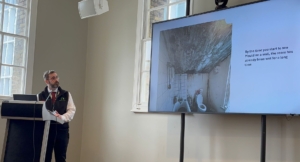
By the time you start to see mould on the wall, the room has already been wet for a long time, he explained, highlighting the fuel poverty cycle and how that can contribute to cases of damp and mould.
Early identification of issues is key and contractors, who are often a primary point of contact for residents, have a huge role to play in identifying issues before they escalate into formal complaints.
Good processes speed things up he said, urging organisations to practice good record keeping, with date and time stamped images to provide a clear audit trail.
Zero tolerance approach
Enfield Council’s Investment Programme Director for Housing & Regeneration, Fiona Williamson, and Head of Construction Management Julie Martin, gave a strategic overview of the borough’s response to Awaab’s Law.
Enfield created a multi-disciplinary group, bringing together housing and property professionals from across the council including housing management, repairs and maintenance (ERD), asset management, compliance, health and safety and Public Health Department.
Its Asset Management Strategy 2026–2029, adopts a zero-tolerance, proactive approach to damp and mould, recognising it as a key driver of resident dissatisfaction and a risk to health and wellbeing.
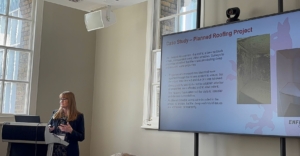
Fiona and Julie outlined how the council is using video-based diagnostics for effective triage and rapid response, had carried out mapping of similar repair requests in blocks to identify potential property issues and involves tenants in all planned works to better enable early identification.
They explained how closer relationships with contractors and consultants lead to effective communication on issues and concerns.
Paul O’Donnell, Managing Director of Lura Construction outlined the company’s role in supporting Enfield, explaining that when its operatives are inside properties installing kitchens and bathrooms, carrying out repairs etc, they have the opportunity to identify concerns, record evidence and escalate properly.
“Our model ensures that we don’t walk past risk,” he said, explaining that all operatives complete a simple checklist when in a home, logging relevant details when risk is identified and feeding the intelligence back to Enfield.
Culture, competence and compliance
Property Services professional Tristan Hemsley took the post-lunch slot with an informative presentation on culture, competence and compliance.
“When we talk about Awaab’s Law, the focus is usually on compliance – timescales, inspections and duties. If compliance is what we do, culture and competence is how we do it,” he said.
He believes that it is time to professionalise housing safety, and culture change is at the heart of that.
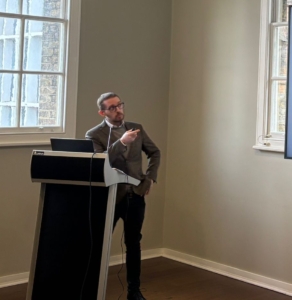
He talked about organisational culture and explained why psychological safety – enabling people to express ideas and concerns openly, ask questions, recognise their mistakes and challenge others including authority figures without fear of negative consequences – is crucial to a positive, supportive and productive working environment.
He talked about seeking second opinions for complex repair issues and why good culture can still fail, as well as outlining what competence is and how we can develop it.
He ended with: “Awaab’s Law mandates outcomes, and outcomes require competence, and competence must be learned, and learning must be evidenced
“Therefore, the question for us is: When the health of a child depends on our diagnosis, are we competent to make it?”
Collaborative approach to Awaab’s Law
The day was rounded off with a joint presentation from Vicky Holland, Head of Specialist Projects at L&Q and Lisa Turner, Head of Repairs Operations at Peabody.
They outlined how the two organisations have been working collaboratively for around nine months to evolve their repairs journeys, with a focus on case management and culture, and a resident-first approach.
They have appointed new recruits selected for their empathy and have named case handlers for all emergency and high-risk cases to ensure consistency
“We can never lose sight of the fact that these are people’s homes,” said Lisa, we need to be confident that the action that we take is the same action we would take with our own family.”
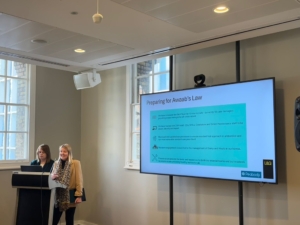
Resident engagement is integral to their approach, empowering residents with the tools and knowledge for healthy homes with information and guidance being shared across a wide range of platforms.
They have also worked collaboratively with the wider sector, attending workshops and feedback sessions with other registered social landlords, working closely with contractors, meeting regularly with the NHF and MHCL,G and working with external partners to access smart technology and digital systems.
“In my 16 years working in social housing, I have never seen collaboration like I have seen with Awaab’s Law,” said Lisa.
As summarised by Echelon Group CEO Mathew Baxter, collaboration and knowledge sharing was a key theme, underscoring the message that the sector is stronger when it works together and there was a real focus on the importance of culture, behaviours and empathy, with some discussion around whether empathy can be taught.
As always, there were plenty of questions from the floor, and much discussion during the networking breaks.
St Vincent’s Centre is home to The Passage, a charity supporting people at risk of or experiencing homelessness, and there were some very generous donations from attendees to support the charity’s vital work.
Visit the events page for more information on future AMIP events.